
The “Delphi in All Its Glory” Series
Five books, over 2,000 pages, seven years in the making. This series covers everything from your first Delphi application to compiler internals, package architecture, cross-platform development, and AI-assisted programming. Every book emphasizes code safety, proper architecture, and building bulletproof software.
All books are available on Amazon (print) and at GabrielMoraru.com (eBook).
Part 1 — Delphi for More Than Mere Programmers
~600 pages · Released 2023

The complete beginner’s guide. No prior Delphi or programming knowledge required.
You’ll start with an introduction to Delphi and a tour of the IDE, then dive into the language itself — variables, types, records, arrays, strings, loops, and routines. From there, we explore object-oriented programming: classes, constructors, destructors, memory management, inheritance, polymorphism, and typecasting. Visual components and their powerful published properties get their own dedicated chapters.
For the adventurous, we tackle advanced abstractions: class methods, class fields, abstract classes, and generics. Along the way, you’ll discover what’s safe to do in Delphi, what isn’t, and — most importantly — why.
Part 2 — Reaching for the Gods
~528 pages · Released 2024

This is where we get serious. The book starts with the Delphi compiler internals — the linker, library paths, and MSBuild — then moves to advanced debugging: reading call stacks, conditional breakpoints, remote debugging, and third-party crash reporting tools like madExcept and EurekaLog.
We’ll tame the compiler’s safety switches (range checking, overflow checking, I/O checking) and learn how to make them catch bugs for us. Then we tackle memory management — FastMM, ownership, dangling references, and corruption — followed by proper exception handling.
For legacy developers, there’s a large section on modernizing old Delphi code for safety, speed, and 64-bit compatibility. Additional topics include multithreading, Windows messages, and a performance showdown with benchmarks against Julia.
Apply these concepts, and your applications will never crash.
Part 3 — Libraries & Packages
~343 pages · Released 2024

We begin by studying the anatomy of a Delphi package — the famous BPL files — and learn how packages help organize code and break circular references. You’ll discover the four rules of packaging and dive deep into the VCL/RTL framework, dissecting the class hierarchy from TObject all the way to TWinControl.
From there, we cover how to design your own library system, leverage precompiled code to dramatically boost compilation speed, and finally untangle the library/search paths that confuse so many developers.
A dedicated chapter covers building custom visual components with design-time and runtime packages. Finally, we venture into the gritty details: the linker, package initialization, component streaming, component states, debugging packages, and the IDE internals themselves.
Part 4 — Crossplatform FMX
~267 pages · Released 2025
One Codebase to Rule Them All.

The world has gone cross-platform, and your code needs to follow. This is the practical, hands-on guide to building, styling, and deploying applications across Windows, macOS, Android, and iOS using the FireMonkey (FMX) framework.
From configuring the SDK/NDK and setting up Android emulators to publishing digitally signed apps on Google Play and the Apple App Store, this book doesn’t skip a step. You’ll learn the key differences between VCL and FMX, master FMX component hierarchies and styles, handle modal forms and dialogs across platforms, and convert existing VCL projects to FMX.
Topics that other books avoid — like code signing certificates, app store paperwork, file deployment, and sandboxing on mobile — are covered in full.
Part 5 — AI-Assisted Development
~416 pages · Released 2026
It is a known fact that AI writes code faster than you. The same can be said about the number of bugs.
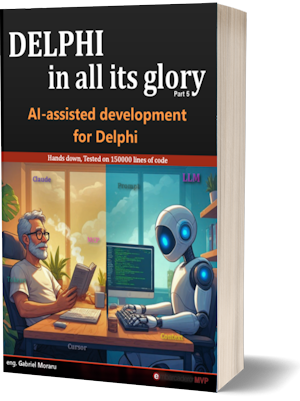
There are a gazillion books about AI out there. This is the only one written for Delphi developers.
No hype. No inflated promises. Just honest results from testing Claude Code on over 200,000 lines of production Delphi code — failures included. From installation to advanced techniques, every example is Delphi-specific.
You’ll learn how LLMs actually work, how to integrate AI into your daily workflow, how to make Claude compile your projects and interpret the errors, and how to teach it your coding conventions with CLAUDE.md files (backed by scientific research showing 29% faster execution). You’ll also see what AI gets wrong — library hallucinations, overengineering, DFM blindness — and how to prevent it.
Advanced topics include MCP servers, hooks, sub-agents, IDE integration options, cost management, and data privacy. Whether you maintain decades-old legacy code or build new applications, this book gives you a straight answer to the question every Delphi developer is asking: does any of this actually work for what I do?
Building Modern GUI Applications… in No Time
Released 2021

This book is for programmers who come from non-GUI backgrounds — Linux/C developers, PHP or Python web developers, Java console programmers. It demonstrates how remarkably easy it is to build professional graphic interfaces with Delphi compared to other languages.
Video Tutorials
I have a YouTube channel dedicated to Delphi video tutorials. More content is on the way.
Open-Source Libraries
You can find my Delphi libraries on GitHub. Some are also available through Embarcadero’s GetIt package manager.
Scientific Publications
- DNA Sequence Assembler — Software (2008–2025)
Domain: medical, scientific
Thousands of citations on Google Scholar from scientific articles and books. - Concepts and Software for a Rational Design of Polynucleotide Probes
Domain: scientific research (2011)
Published in Environmental Microbiology Reports, 69–78.
Moraru, C., Fuchs, B.M., and Amann, R.
What readers say
Selected reviews from Amazon (verified purchases):
“It covers all topics it pretends to cover, and more! I totally recommend the book.”
— BigData ★★★★★ (Book 1, Amazon.de)
“The book is pleasant to read as it is not written in a very formal way. For me, it was a nice help with getting in touch with Delphi again after working with other languages for more than 20 years.”
— Chris Strobel ★★★★ (Book 1, Amazon.de)
“I got the book to improve my Delphi skills and it really helped. I would like to recommend it not only to people with previous knowledge but also to anyone who wants to get started.”
— Alberto ★★★★★ (Book 1, Amazon.de)
“Did I reach the Gods after reading the book? No. Did I learn really advanced Delphi stuff? Hell yeah! Totally recommended.”
— BigData ★★★★★ (Book 2, Amazon.de)
“Delphi community was waiting for this book for ages! I looked around and there is no book dedicated to this subject. The book is damn good documented and the examples are right on spot. AND the book made me realize that I don’t have to be afraid of packages.”
— Martin ★★★★★ (Book 3, Amazon.de)
“Great book, I learned a lot.”
— Ole ★★★★★ (Book 1, Amazon.com)
“I wanted to learn some Delphi, and I was unsure about the book but gave it a try. It was exactly what I needed. The book is very complete.”
— Raik Baugatz ★★★★★ (Book 1, Amazon.de)
“Fit the bill for Delphi — cleared questions I had.”
— Pedro Rios ★★★★★ (Book 1, Amazon.com)